
precious things, and he furnished the monastery church with the finest and most costly icons, books and liturgical vessels: “He donated also costly icons adorned with pearls and gold, supplied (it) with various service books, vestments and church vessels, (likewise) gilded and adorned with great pearls, surpassing even the chosen great lavras on the Holy Mountain.” [ŽDS 52]. Despite the hard times and the challenges that struck the land, the work lasted, with minor interruptions, until 1418. Within the magnificent walls of the monastery fortress, on the spot where a new monastic community was founded, where divine grace was poured out and met with faith and resolve, the Serbian Patriarch Kiril (1407–1419), with a council of Serbian hierarchs, came to the Despot's endowment on the feast of Pentecost - the Descent of the Holy Spirit upon the Apostles, consecrating this holy place on Trinity Day in 1418. At the consecration, besides the Serbian episcopate, the abbots of the monastic communities of the Serbian lands and the nobility were also gathered. In the monastery church, Despot Stefan raised a tomb for himself, where, not long afterward, his relics would be laid. His care for Manasija Monastery did not cease even to the last moments of his life, for this monastery represented more than a monument of a ruler's power. According to Constantine the Philosopher, Despot Stefan “throughout his whole life did not cease to bestow abundantly the finest gifts” [ŽDS 52]. Thanks to the breadth of spirit and the vision of the holy Despot Stefan, Manasija Monastery with its Church of the Holy Trinity - a sacred edifice whose harmony points to the achievements of a symphony of spiritual growth and cultural renewal - became not only a beacon of faith but also a nursery of culture, preserving a priceless treasure of art, knowledge and learning. This church still speaks today of a ruler who understood that faith, culture and the spirit of authentic humanity are the strongest foundations of a people.
The Architecture of the Church of the Holy Trinity
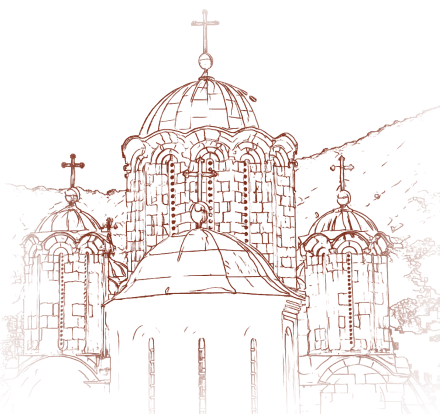
The church dedicated to the Holy Trinity, the spiritual and architectural center of the Manasija monastery complex surrounded by a fortress, represents the summit of the Morava style of Serbian medieval architecture. Its importance lies not only in its spiritual role but also in its architectural innovation and aesthetic expression. It was built of alternately cut ashlar blocks bound with layers of mortar, with minimal use of brick in certain places. The facade of the church is made of sandstone, of flat stone blocks carefully arranged in regular courses. The walls are set on a high and