
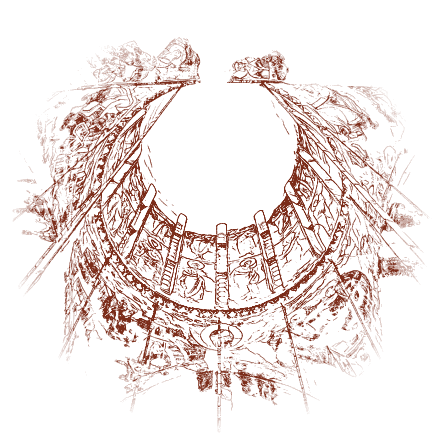
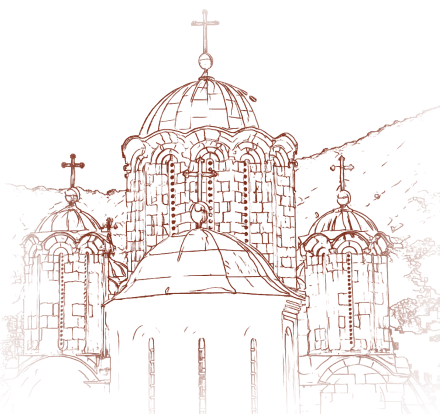
Despot Stefan Lazarević, having succeeded in restoring the Serbian state and gathering most of the Serbian lands under his rule, built his endowment in Resava. The grandeur of Manasija Monastery, adorned by its central edifice, the Church of the Holy Trinity, captivates and takes one's breath away even today. So extraordinary is the beauty of this church that in the century before last the renowned German travel writer and archaeologist Felix Kanitz recorded that it was “the most remarkable building in Serbia, and perhaps in Europe.” According to the testimony of Constantine the Philosopher, the Despot sought out, in various lands, skilled and “the finest builders and experienced painters” for his endowment, and he beautified the monastery church with golden ornaments and floral patterns. In the monastery church the Despot raised a tomb for himself, in which his relics were later laid. The church dedicated to the Holy Trinity, the spiritual and architectural center of the Manasija monastery complex, represents the summit of the Morava style of Serbian medieval architecture. The frescoes of this church represent the summit of the Morava School and a significant example of the late Byzantine classicism of the Palaiologan era. The frescoes of Manasija are recognized as the high point of the visual culture of that period, and historical sources describe them as a marvel of beauty that aroused admiration.
The Church of the Holy Trinity of Manasija Monastery
The Resava region itself had inherited a church history even before the holy Despot founded Manasija Monastery. The richness of this church history is attested by numerous archaeological sites in the Resava area, many of which have yet to be investigated. It is interesting that, according to certain old Serbian manuscripts, among the bishops whom the first Serbian Archbishop, Saint Sava Nemanjić (c. 1175–1236), appointed with his own hand, the bishop of Resava is mentioned in fifth place (as recorded in the