
Orthography, copies, translations
The Resava School
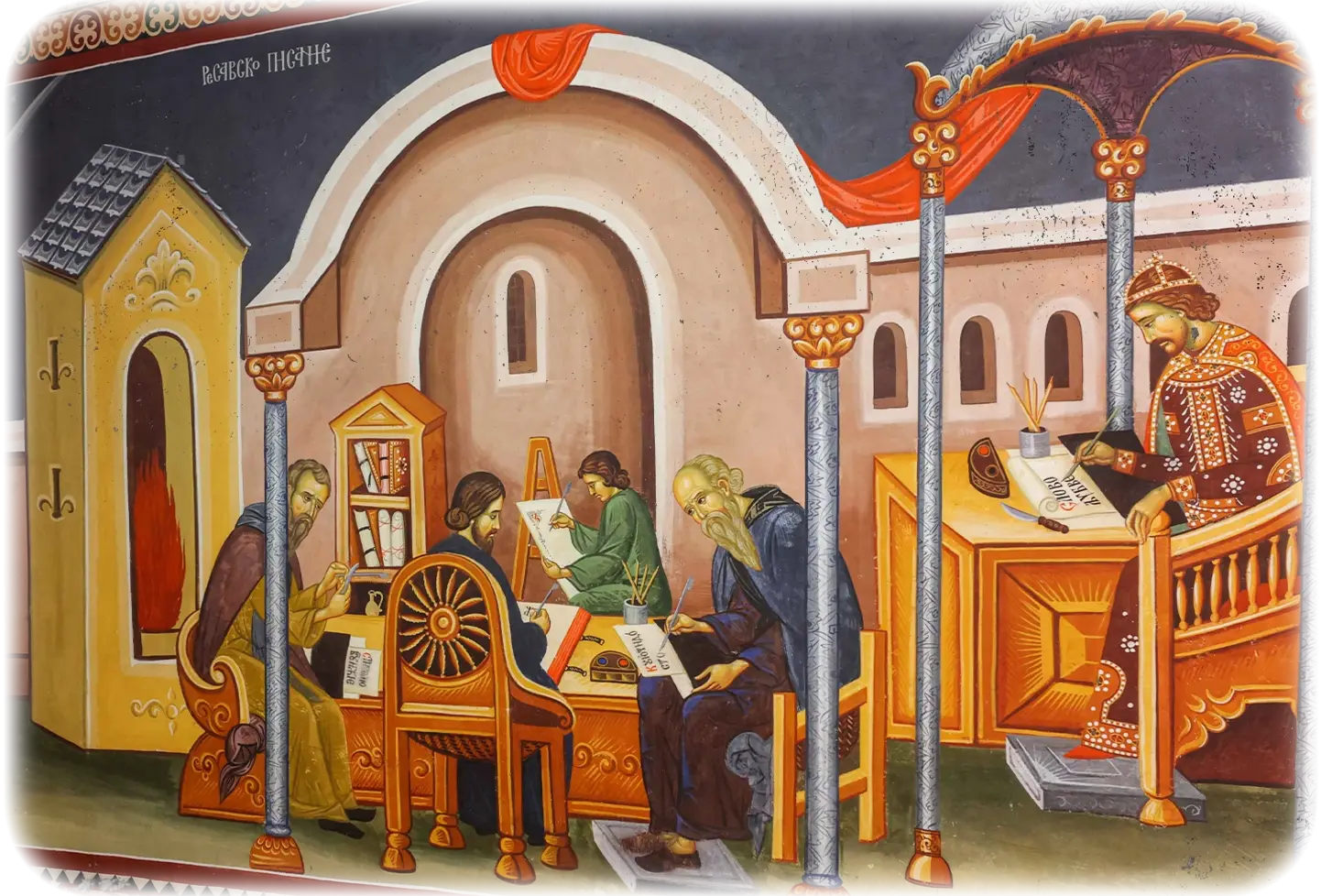
In just two decades shared by the founder and his endowment (1407-1427), Resava became a shining star of Serbian cultural history. Under the aegis of the “Serbian teacher” Constantine the Philosopher, the Resava School was born - a school of orthography, copying and translation.
The founder, Constantine writes, gathered “from all sides very wise and exceptional monks”. Their translations and copies remained highly regarded until the end of the 17th century.
THE RESAVA SCHOOL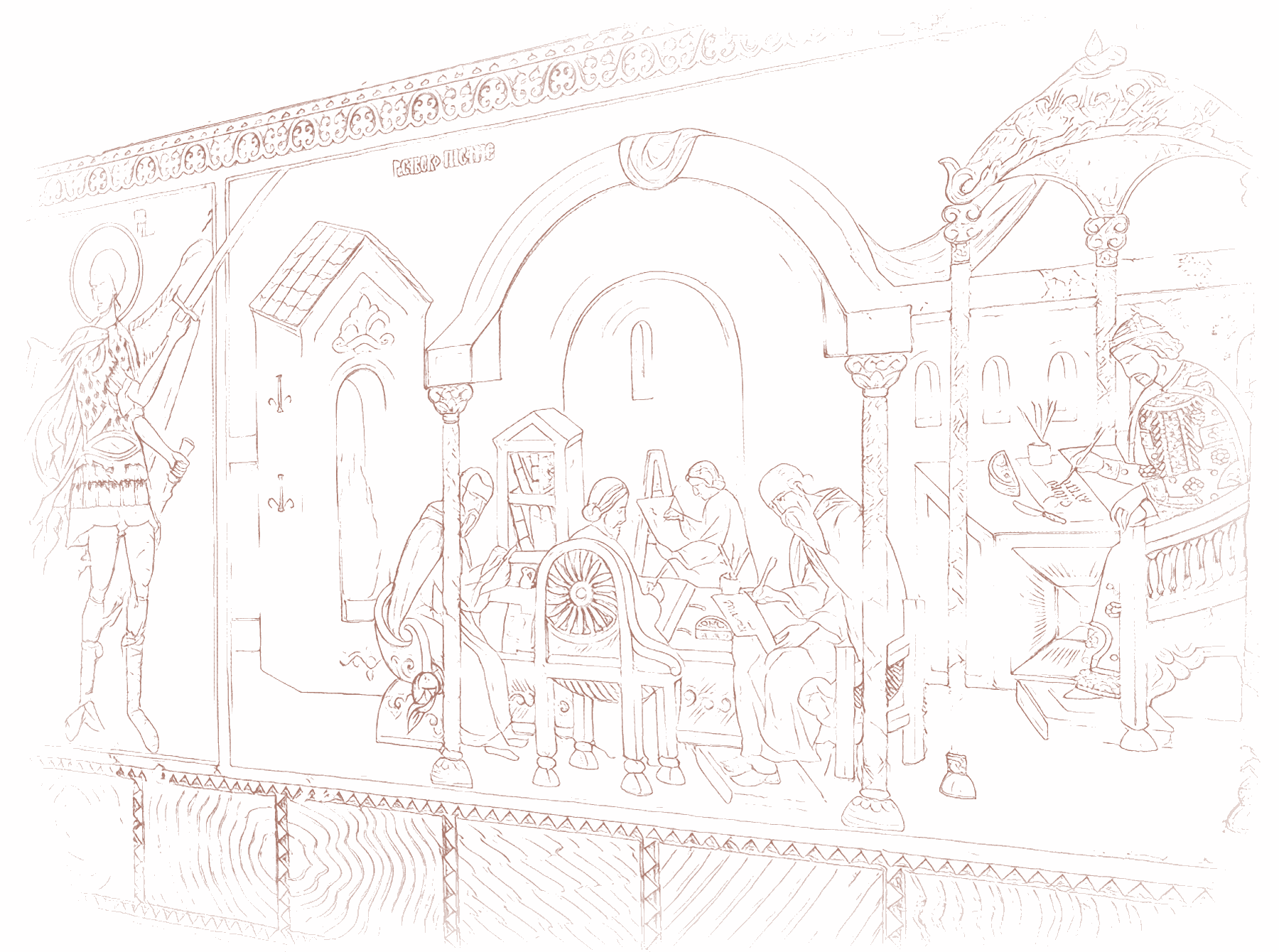
A refuge for men of letters
Late 14th and early 15th century
A Refuge for Scholars
Fleeing the invaders from Asia, writers, grammarians and translators sought refuge in the Serbian lands. Despot Stefan took in refugees from the devastated Byzantine lands, and the monasteries of Braničevo were home to the Sinaites - Serbian, Bulgarian and Greek hesychast monks.
In their monastery cells they translated works from Greek that had never been translated, corrected old translations and carefully copied them. Many names have not survived - because of the fall of the state, but also because of the monastic humility that led them to leave their names unrecorded.
LEARNED MONKSScribes and translators
- Constantine the Philosopher
- “the Serbian teacher”, author of the Treatise on Letters and the Life of Despot Stefan
- Grigorije Camblak
- abbot of Dečani, later Metropolitan of Kiev
- Andonije Rafail Epaktit
- author of the Encomium of Prince Lazar
- The Monk from Dalša
- a monk of Mount Athos who copied many books for the Despot
- Grigorije of Hilandar
- corrected the Chronicle of Zonaras against the Greek original
- Priest Venedikt
- translated the Hexaemeron of John Chrysostom on Mount Athos
The first philological treatise in Serbian literature
Treatise on Letters
With every copy, errors multiplied, and the time was ripe for reform. After 1423 the Despot asked Constantine the Philosopher to compose a treatise on orthography - the Treatise on Letters (Skazanije o pismeneh), also known as the Story of Letters. Written in Belgrade - or, according to some scholars, in Resava - it was the first major attempt to establish the rules of Resava orthography.
Constantine drew on the reform of Saint Euthymius of Tarnovo and returned orthography to its original Cyrillo-Methodian norm, following the Zeta-Hum, Bulgarian and Greek traditions. Some later found his rules complicated, but the very fact that an extensive treatise on orthography was written in 15th-century Serbia testifies to the scholarly progress of the age.
“In the days of the pious Despot Stefan”
Scribal notes in manuscript books
Books of the Despot's Age
1402
“Holy and divine books” donated to Dečani by Ecclesiarch Varlaam.
1407/8
On the Despot's order, Grigorije, a monk of Hilandar, corrects the Serbian translation of the Chronicle of Zonaras.
1408
The scribe Radič copies the Lenten Triodion “by order of the great lord of all the Serbian land”.
1413
Hieromonk Jovan copies a panegyric at the monastery of Lešje, on the Despot's order.
1418
The four Books of Kings are translated from Greek beneath Mount Prozrak, near Ljubostinja.
1424
Priest Panaret compares the text with the Greek and records the shortcomings of the existing translation.
1426
On Mount Athos, Priest Venedikt completes his translation of the Hexaemeron “in the days of the wise and gracious and glorious Despot Stefan”.
According to research by Irena Špadijer, we know today of more than twenty books that belonged to the Despot - among them a Ladder at the Athonite monastery of St. Paul and a Commentary on the Gospels at the Romanian monastery of Neamț.
Initiator of the Resava Renaissance
The Book-Loving Despot
The Despot, Grigorije of Hilandar records, cared for books so much “as if he had no other cares or duties”. He is believed to have commissioned the famous Munich Psalter. The Karlovci Genealogy says that he “translated many writings from Greek writings, more than others before him”.
- The Homily on LoveAn epistle in acrostic, a hymn to love - the summit of Serbian medieval poetry.
- The Inscription on the Kosovo PillarA solemn epitaph at the site of the Battle of Kosovo, probably 1402-1404.
- On Future TimesA text the Despot probably translated from Greek himself, between 1400 and 1407.
From Krušedol to Russia
After the fall of the Serbian Despotate
The Resava Legacy
Resava orthography remained the norm until the twilight of the Serbian state - it was also used for the Varaždin Apostol of 1454, commissioned by Katarina Branković. After the fall, some monks left with the Brankovićs for Srem, Fruška Gora and Krušedol, others for Wallachia, and Pachomius the Logothete for Russia - carrying with them the rules of the Resava School, the Life of Despot Stefan and his cult. Others remained around the Patriarchate of Peć and Dečani.
Centuries later
Without Fault
Two centuries later, copyists still sought out Resava models. In 1638 the monk Mihailo copied an Apostol from “the old Resava translators”; in 1644 Priest Manasije of Trnovo asked his readers to correct his copy against the “Tarnovo and Resava” exemplars.
“from the old Resava translators who have no faults at all”
Though deserted, the monastery of Resava remained a bridge between the past and the future - a guardian of the Christian heritage that joined tradition with the ideas of humanism that were still to come.
READ THE FULL TEXT