

Housed on the upper floor of the guest lodge of Manasija Monastery, in the shadow of the magnificent Manasija Church of the Holy Trinity, the monastery library occupies a special and prominent place in the life of the Resava monastic community. In a certain sense, its roots reach back to the very beginnings of monastic life at Manasija Monastery, that is, to the time of Saint Despot Stefan.
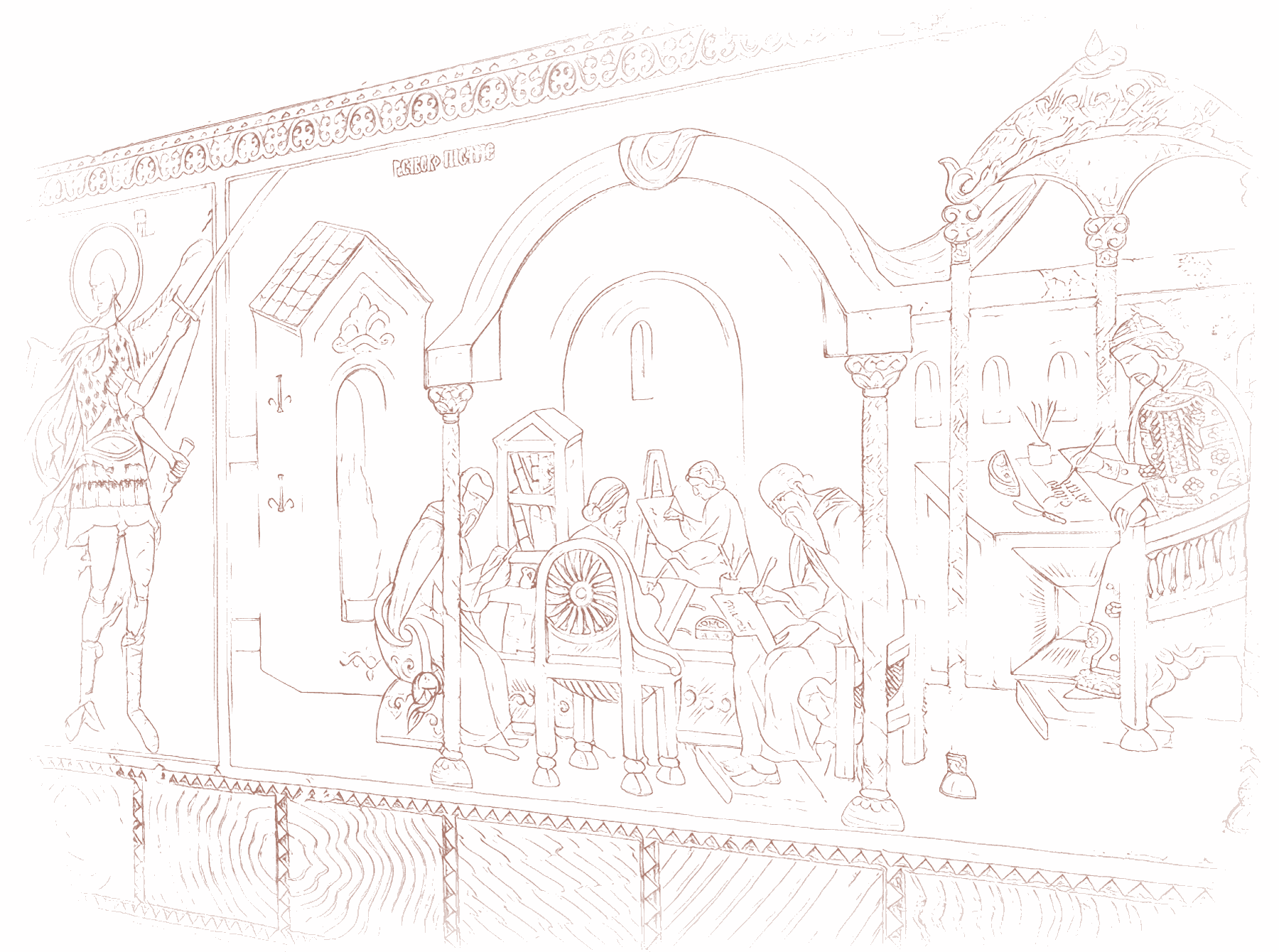
At the close of the 14th century and in the first quarter of the 15th, in the time of Holy Prince Lazar and his son, the right-believing Despot Stefan Lazarević, the Morava region became the radiant pivot of Serbian medieval culture. In the golden rays of political and economic ascent, monasteries and churches sprang up like pearls of spirituality and knowledge. The greatest among the churches built at that time, the endowment of Despot Stefan, Manasija, became the gathering place of the most learned minds of the age. In that period the famous Resava School flourished; in the Resava region works of immeasurable value were copied and composed. Learned monks gathered Greek scrolls from Mount Athos and Byzantium, Latin and Hungarian books, as well as manuscripts produced in the Serbian lands, forming a priceless treasury of spiritual culture. It is presumed that, as the cultural center of the Serbian Despotate, Manasija Monastery was furnished with a suitable library.
The inventory and the book treasures of that library are, unfortunately, unknown to us. The original monastery library shared the fate of the monastery and its monks. It is presumed that the Manasija library was considerable: in view of the fact that the pious Despot Stefan was and remains known as a lover of books and a bibliophile, and in view of the testimony of Constantine the Philosopher recorded in the Life of Despot Stefan - that the founder of Manasija Monastery furnished his endowment with various books [ŽDS 52] - researchers consider that the original Manasija library was first and foremost a treasury of liturgical and spiritual books, intended above all for the monks. Since Manasija Monastery was raised as a renowned monastic complex, it is believed that the former monastery library did not lag behind the libraries of the renowned monasteries of its age, such as the library of the Athonite monastery of Hilandar. When to this are added the hypotheses that Manasija Monastery was one of the important centers of the Resava School, that a scriptorium existed in the Resava monastery, and that in the first half of the 15th century the Resava monks labored diligently within the walls of Manasija at copying and preserving manuscript books, one can sense the importance of this library and the quantity of manuscripts it held.
However, in the 15th century the Turkish conquerors brought destruction and desolation with them, burning along with the monastery many manuscripts of this glorious library. It is therefore very difficult today to speak of the former wealth of the monastery library, for precious manuscripts and records, among them those produced in the Resava School, vanished in the whirlwinds of invasions and devastation, in plunder, fires and demolitions. Suffering in relocations, burned and destroyed, this treasury of spirituality lost many of its priceless works. Only a few surviving fragments of the former book treasures of the Serbian Despotate, individual manuscripts which by some miracle were preserved and are today kept in monastery treasuries, museums and libraries throughout the world, from Mount Athos to Moscow and London, bear witness to the former splendor of the Serbian book, and to the care, labor and skill of the monks who, toiling at copying, translating and correcting manuscripts, created true works of art of priceless value. The largest number of surviving Resava manuscripts is on Mount Athos; a number of manuscripts reached Russia, where they remain to this day; in Serbia, the most Resava manuscripts are found in the Patriarchate of Peć and in the Patriarchate of the Serbian Orthodox Church in Belgrade. A small part of the spiritual heritage was thus preserved, but the Serbian medieval written treasure was for the most part destroyed: just as Manasija Monastery was plundered, burned and seized, so too the original monastery library was destroyed, looted and scattered.
In the brief period of the monastery's renewal in the 18th century, books came to Manasija Monastery along with the monks. But after the migrations caused by Turkish campaigns of conquest, some books fled with the monks to safer regions: some of the books from the Manasija library of that time have been preserved in the monasteries of Fruška Gora.
Today's Manasija library, into which the Resava monks have been depositing book treasures since the beginning of the 19th century - in the middle of which century the first inventory of the monastery's library holdings was also drawn up, mentioned by Josif Veselić (1823–1873) - is located on the upper floor of the guest lodge and housed in two connected rooms. In the larger, sunlit room there are glazed wooden display cases filled with books, and this space is at the same time a reading room, with work tables and places for readers. Here are kept more recent publications, mostly of spiritual, cultural and historical content.
The smaller room preserves the most precious books - old and rare liturgical writings, books of Holy Scripture, Gospels, Lives of saints, menaia, as well as the chronicles of Manasija Monastery, memorial books and the monastery's archival materials. This space is not only a library but also a kind of museum and archive of history, spirituality and cultural heritage. This library represents a treasure not only of Manasija, but of all Upper Resava and of Serbia, for it bears within itself a testimony to a centuries-old cultural heritage.
Some 7,500 library items are recorded in the Manasija library. Particularly precious manuscripts and rare old books and publications are listed and inventoried in a catalogue published in 2020 under the title Manuscript and Old Printed Books in the Territory of the Pomoravlje District. This publication is a kind of testimony to the development of literary culture in this region. The research showed that the library of Manasija Monastery is the most important and the richest in the district. Its holdings, besides five manuscript books, include over 120 old printed books, which, under the Law on Old and Rare Books, constitute cultural property of exceptional importance.