
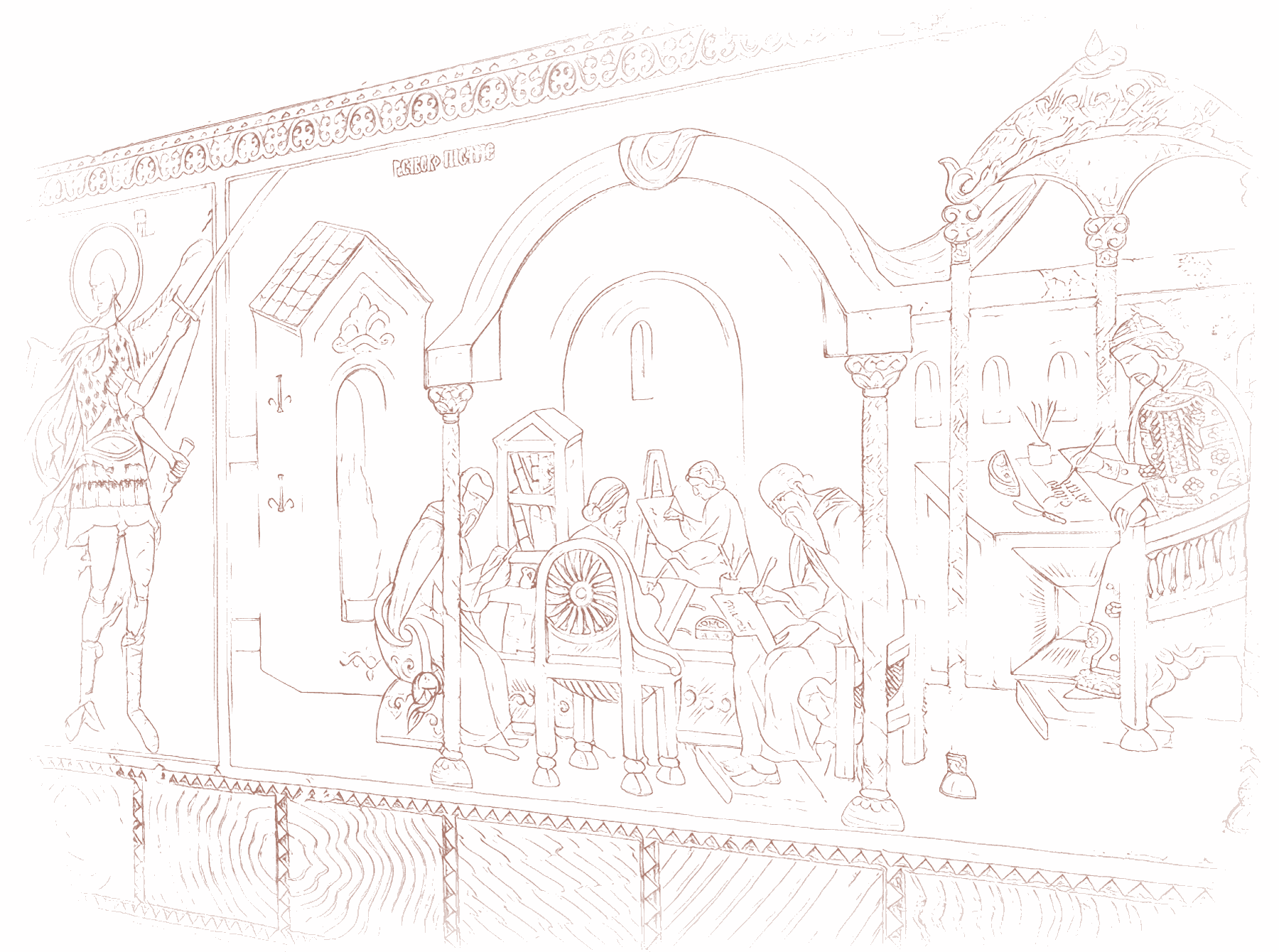

withdrew together with the last Brankovićes to Srem. There they continued their work in the monasteries of Fruška Gora, such as Krušedol, which became one of the new centers of spirituality and culture. Another part of the monks found refuge in Wallachia, while certain Serbian monks, such as the celebrated Pachomius the Logothete († before 1484), went to Russia. These émigrés carried with them not only the orthographic rules of the Resava School, but also the writings of Constantine the Philosopher, above all his Life of Despot Stefan, as well as the cult of the Holy Despot. In this way they spread the spiritual and cultural achievements that had been attained in the Serbian lands, leaving their mark on the cultural history of those countries. A part of the monks remained in the south of Serbia, where they gathered first around the Patriarchate of Peć and the Monastery of Dečani. In those hard times they did everything to preserve the tradition, Orthodox spirituality and the heritage of medieval Serbian literature, struggling so that, despite historical misfortunes, the continuity of cultural life would not be lost. Thus works in the Resava orthography continued to be produced even after the fall of the Serbian state. The Baranja copy of Dušan's Code, for example, made in the first quarter of the 16th century, is distinguished by certain norms of the Resava orthographic school. Despite hard historical circumstances, the literary splendor of Resava endured even after the fall of the Serbian state, and the influence of the Resava School and of the literary reforms that issued from it persisted in the following centuries as well, as the men of letters and copyists themselves testify in their notes. Thus, for example, the monk Mihailo at the Skete of Saint Anne in 1638 copied an Apostolos from "the old Resava translations," which have no flaws; he donated this copy to the Athonite Monastery of Saint Paul [SSZN 1308]. The priest Manasije from the Bulgarian town of Tarnovo in 1644 copied the book of the Pentekostarion; uncertain of the results of his work, since he did it in unquiet times, faced with adversities and hardships, the copyist asks his readers, should they notice any deficiency in this copy, to compare it with the "Tarnovo and Resava" exemplars, and to correct the text according to them [SSZN 1384, 6814]. With the blessing of Viktor, abbot of Hilandar, in 1660 an unnamed Hilandar monk copied on Mount Athos an Apostolos "from a good exemplar," that is, "from the old Resava translations which have no defect whatsoever" [SSZN 1570]. The Resava orthographic school thus proves to be not only a center of literacy, but also a symbol of cultural renewal and of the historical endurance of the Serbian people and their spirituality. Having blossomed under the patronage of Saint Stefan Lazarević, the Resava School influenced all aspects of cultural life - from orthography and literature to history and faith. Resava Monastery, from its founding a refuge for writers and copyists, though it fell desolate, remained, through the influence the Resava School exercised, a kind of bridge between past and future, preserving the Christian heritage while at the same time joining tradition with the ideas of humanism that were only then arriving.
Manasija Monastery · Imperial Lavra of the Holy Trinity
Manasija
loading the page