
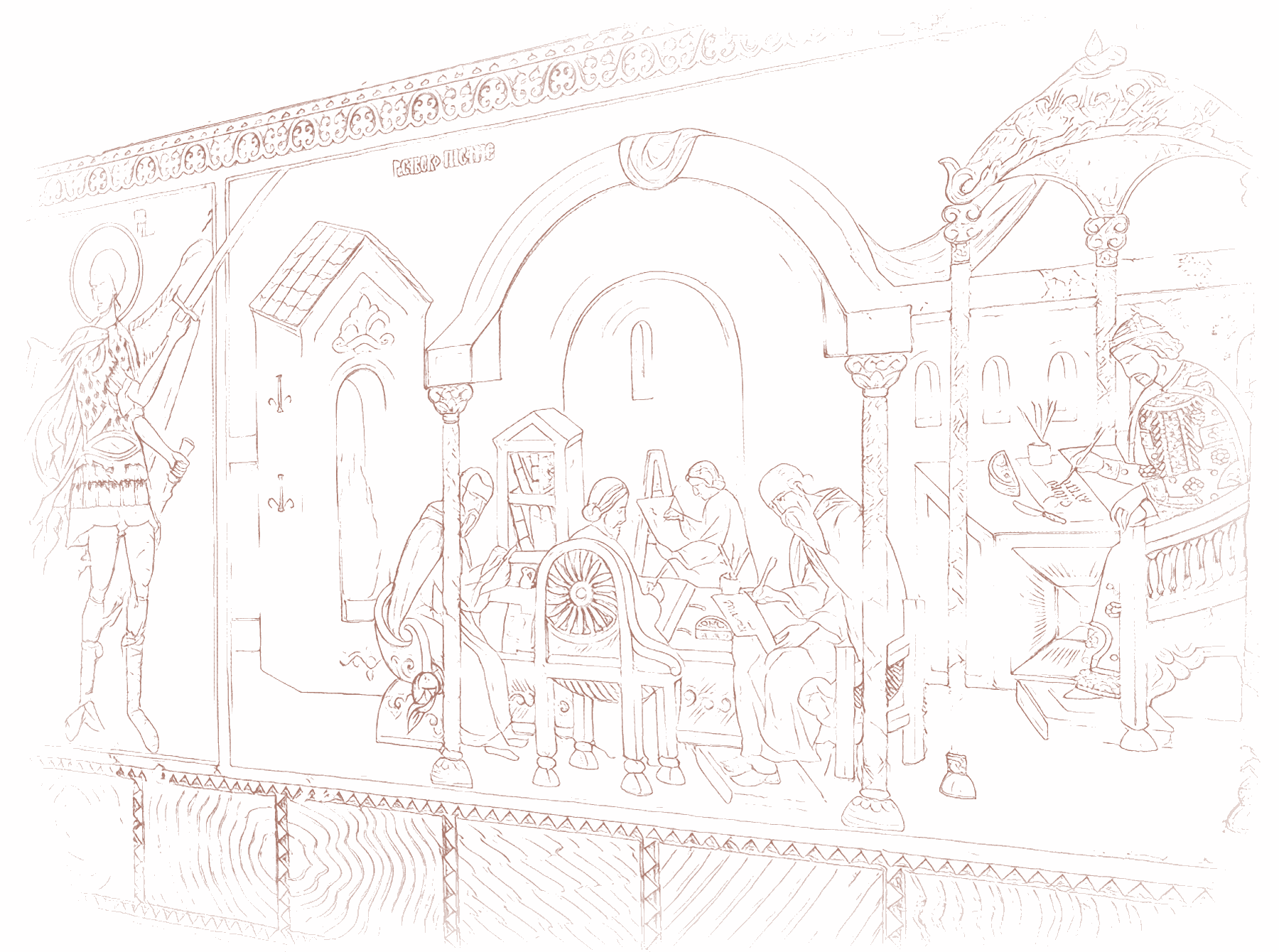

toward the Serbian lands into a kind of cultural exile. In the time of the awakening of spirituality and of cultural flourishing under the patronage of Despot Stefan Lazarević, the Serbian Despotate was a kind of refuge for the cultivators and creators of the culture, learning and art of the late Middle Ages. In that noble hinterland of light, in Resava Monastery, there arose at that time the so-called Resava orthographic school - the cultural fortress of the Serbian recension of the Old Church Slavonic language. This school united within itself orthographic, copying and translating activity. Its significance, like the reflection of a star in the dark night sky, illumines the development of Serbian literacy all the way to the 18th century. In the span of only two decades of the shared existence of the founder Stefan Lazarević and his masterpiece, Resava Monastery (1407–1427), this holy place became a shining star of Serbian cultural history. Resava, like a spiritual and cultural fortress, acquired a significance that surpassed the time in which it arose, and became a symbol of the enlightening spirit of the Serbian Middle Ages. Beneath its vaults, under the protection of the "Serbian teacher," Constantine the Philosopher, on the waves of a language reform set in motion earlier, the celebrated Resava orthographic school was born. This school was not merely a place for the simple copying of books - it represented a refuge for literacy and thought, where the power of the word joined with wisdom in order to correct the errors that had arisen through careless translations and copies. Constantine the Philosopher, as man of letters and grammarian, translator and historian, laid the foundations for a thorough reform of Serbian orthography. His vision is gathered together in the treatise entitled the Treatise on Letters, which was written with the aim of showing how Slavonic books ought to be written. This work, with its complex and somewhat difficult-to-apply orthography, influenced later writers, who adopted it and used it over the following centuries. Although some later criticized this orthography for its complexity, the very fact that in the 15th century an extensive treatise on orthography was written in Serbia testifies to the cultural and scholarly progress of that time. The Resava School, however, did not shine only in the field of orthography. Its greatest strength lay in the literary and translating work it carried out in Manasija Monastery and in other cultural centers. The translations and copies created under its roof enjoyed particular esteem until the end of the 17th century, testifying to the lasting value of this cultural undertaking. Resava Monastery was from its founding inhabited by the wisest monks: according to the testimony of Constantine the Philosopher recorded in the Life of Despot Stefan, the founder of Resava gathered "from all sides very wise and distinguished monks" and settled them in Manasija Monastery [ŽDS 52]. Thus this monastery, from the beginning of its historical existence, became a cultural center, making possible the development of an orthographic school that was not only a place where errors in texts were corrected, but also a place where works came into being that would be a signpost for the generations to come. This school not only influenced Serbian cultural history, but by its work left its mark on the entire Slavic world, transforming Resava into a symbol of wisdom, dedication and love of knowledge.
Manasija Monastery · Imperial Lavra of the Holy Trinity
Manasija
loading the page