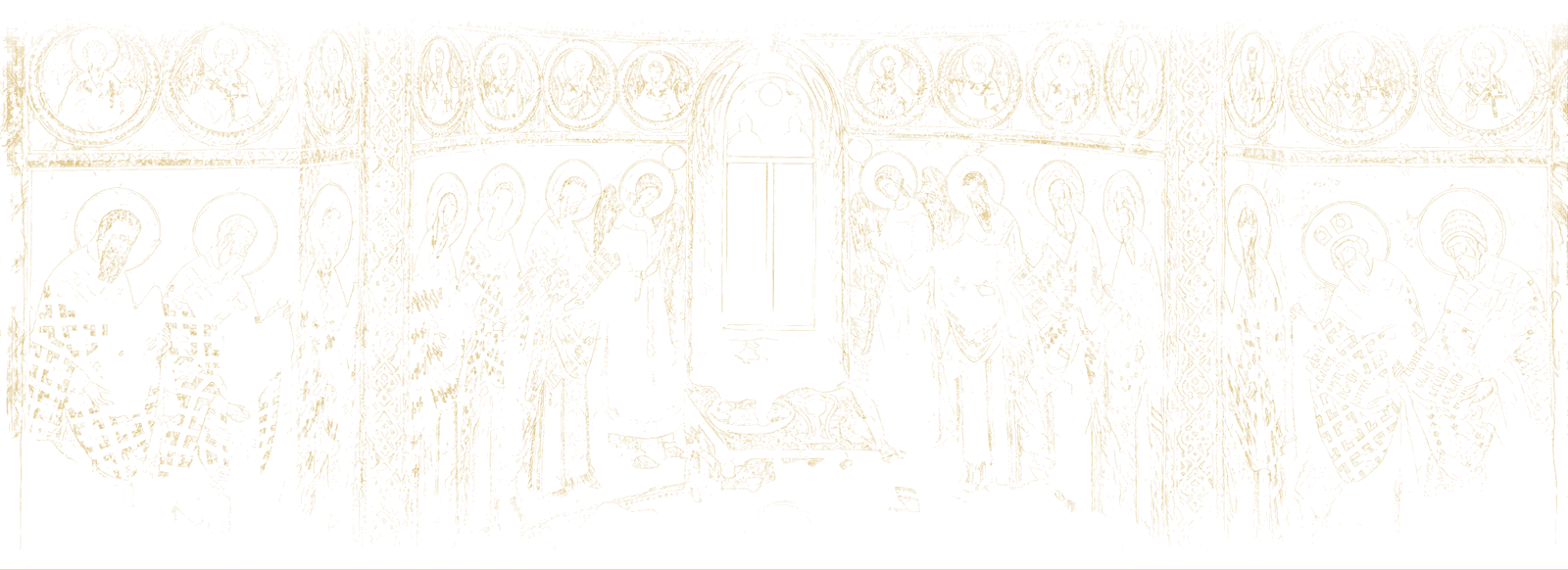
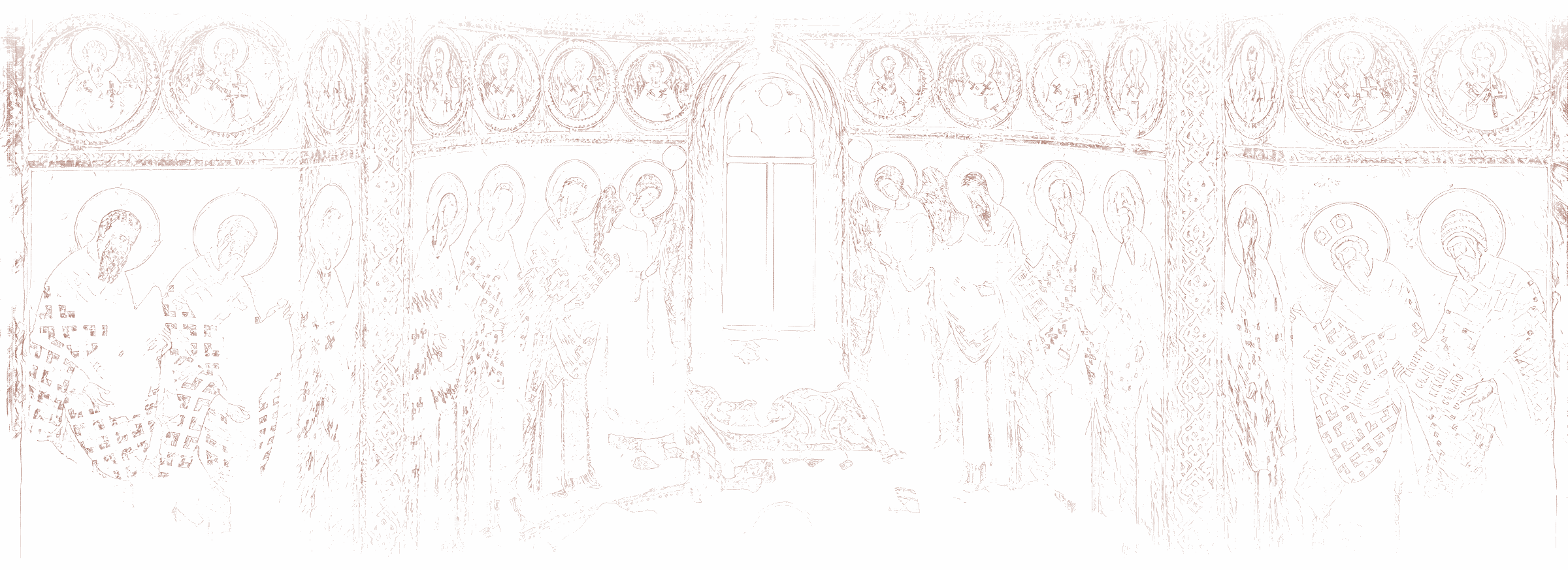
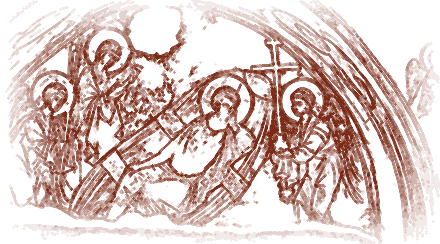
of the church monumental compositions and figures of saints have been preserved, which still offer insight into the original thematic structure and arrangement. The painting preserved in the nave of the church of Manasija Monastery represents the summit of the sacred art of Serbia and stands out for its sumptuous aesthetic and theological depth. Despite the damage, the remains of the painting bear witness to the spiritual and artistic greatness of this monastery, as well as to the extraordinary effort of Despot Stefan Lazarević to raise the art of his endowment to the highest level.
The Wall Paintings
The wall painting of the Church of the Holy Trinity at Manasija, though preserved only in part, represents the summit of the visual arts of the beginning of the 15th century and a significant example of late Byzantine painting of the Palaiologan era. Its execution was most probably completed by 1418, on the eve of the great council that the holy Despot Stefan organized on the occasion of the consecration of the monastery. The frescoes of Manasija Monastery reflect, on the one hand, the strong and deep political, economic and cultural ties of the Serbian Despotate with the Eastern Christian Romaic heritage, and on the other, with the Littoral and the West. They are recognized as the high point of the visual culture of that period, and historical sources describe them as a marvel of beauty that aroused admiration. The painting of Resava is mentioned in a famous saying that arose among the Serbian people, which was written down as early as the first half of the 15th century, before the repose of the holy Despot Stefan, by the author of the Karlovci Genealogy, and which reads: “The pavement of the Prizren church, and the church of Dečani, the narthex of Peć, and the gold of Banjska, and the painting of Resava are found nowhere else” [SSRL 26] - that is, that nowhere can one find architectural and artistic achievements such as the floor of the Prizren church [of the Monastery of the Holy Archangels], the church of Dečani [of Christ Pantokrator], the narthex of Peć [i.e., the narthex of the Patriarchate of Peć, which connects all three churches of the patriarchal complex], the gold of Banjska [i.e., the gold leaf with which the backgrounds of the frescoes were covered in the Church of the Holy Archdeacon Stephen of Banjska Monastery], and the painting of Resava - the frescoes of the Church of the Holy Trinity at Manasija. There is also an opinion that the “writing of Resava” refers to the manuscripts produced in the Resava School - and the dispute over the meaning of this expression has still not been settled. Unfortunately, during the Ottoman conquests and later during the period of Turkish rule, a considerable part of the painting of the church of Manasija was damaged or destroyed. Of the roughly 2,000 square meters of the original painting, somewhat more than a third has been preserved, and that in the nave of the church. The frescoes in the narthex have been lost, except for a few faded fragments. In the nave